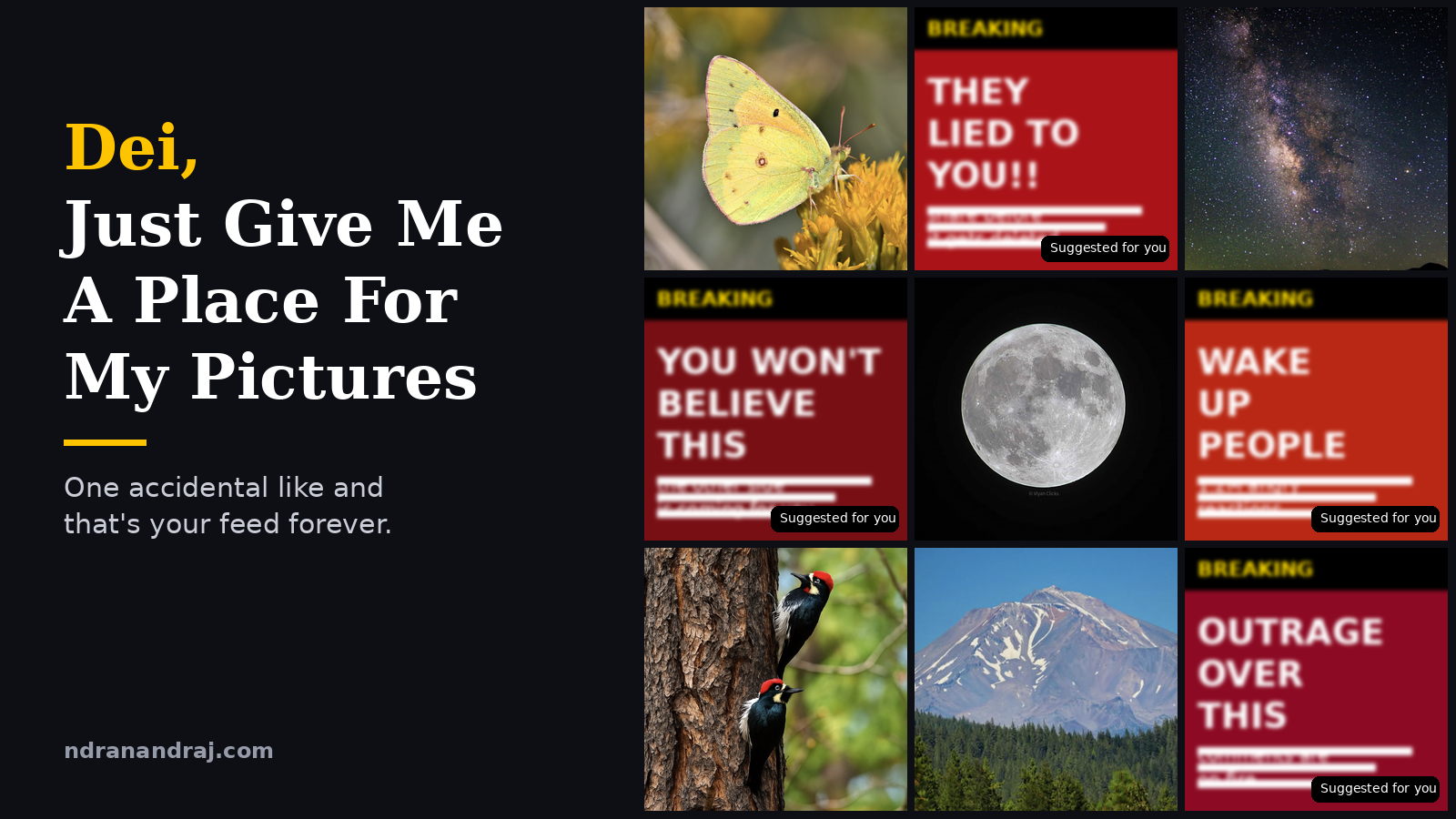
Cover photos: all taken by me. More on my Instagram: @ndranandraj
A friend told me something a few weeks ago that I can’t stop thinking about.
“Your nature pictures are boring, da. I’d rather watch political reels.”
Not my butterfly. Not the woodpeckers in my backyard. Not the Milky Way I spent hours shooting under a dark sky. He wants the stuff that makes him angry, because that is what keeps him hooked.
I laughed it off. But he isn’t wrong about what hooks him. And that is exactly the problem.
Instagram started as a simple place to share pictures. Photographers, artists and creators loved it. Today it feels like a tool for propagandists, and my Milky Way is stuck between two political rants.
So how did we get here?
The app has one job
Every social media app wants one thing: keep you scrolling. More scrolling means more ads, and more ads means more money.
So the app watches everything. What you like, what you save, how long you stop on a post, even the two extra seconds you paused on a video. Then it guesses what will keep you there next.
It doesn’t care if it’s true. It doesn’t care if it’s good for you. It only cares if you’ll stop and look.
One like on a parotta picture
Here is what happened to me on X.
Someone I follow posted a picture of parotta with salna. Flaky, layered, with a bowl of hot salna on the side. I couldn’t help it. I liked it.
Big mistake.
For the next few hours, my feed was only food. Street shop biryani, roadside kothu parotta, fancy star hotel plates, dosas, burgers, desserts. One like, and X decided I was a foodie now.
Another day, I bookmarked a post about a new AI model to read later. Just a bookmark. Not even a like. Over the next few days, I saw more AI content than I had in my entire life. New tools, hot takes, and endless “AI will replace your job” threads.
Funny with food. Annoying with AI. But the exact same thing happens with politics and religion. One click on a heated post, and your feed slowly fills up with the same side of the same argument, again and again.
The trap you don’t notice
The scary part? It doesn’t feel like a trap. It feels like the whole world agrees with you.
The other side never shows up. Not because it doesn’t exist, but because the app decided you wouldn’t click on it. So when you finally meet someone who thinks differently, they seem strange. Or stupid. Or even dangerous.
Growing up, we lived with people who thought differently. Different religions, different politics, different food. We argued, we laughed, and we still sat together for tea.
The feed doesn’t allow that. It only sells one story: us vs them. And honestly, I think it’s making us dumb. Not because we aren’t smart, but because we have stopped hearing anything new.
I want the opposite. I want to see views I disagree with. Even better, ones that prove me wrong.
Bad news always wins
A sunrise post gets a few likes. An angry post gets hundreds of comments, shares and fights in the replies. The algorithm sees all that noise and thinks, “People love this. Show it to more people.”
This isn’t just my feeling. An MIT study in Science found that false news spreads faster and further than the truth. A study in PNAS found that posts attacking the “other side” get far more shares.
So the kind story, the beautiful picture, the thing someone learned today, all of it gets buried.
And you feel it. You open the app in a good mood and close it sad, anxious or just pissed off for no reason. You didn’t have a bad day. You just scrolled through one.
Who is really writing your feed?
Here’s the part that should worry all of us.
If you understand the algorithm, you can use it. Political parties, interest groups and even foreign actors run hundreds of accounts, post the same message in slightly different words, and boost each other. The algorithm sees the activity and pushes it to millions.
Suddenly a planned narrative looks like public opinion. That’s how views get shaped before an election and how one version of a story becomes “the truth” in a few hours.
You don’t need to control the news anymore. You just need to understand the feed.
What you can do today
- Switch to the Following feed. Instagram and X both have one. It shows only people you follow, in order.
- Tap “Not interested” whenever a post drags you somewhere you don’t want to go.
- Reset your suggested content in settings for a fresh start.
- Follow one thoughtful person you disagree with. Not a troll. Someone calm.
- Notice how you feel. If you close the app angry every time, put the phone down.
The platform I’m waiting for
Here’s what I actually want:
- A chronological feed by default. Posts from people I follow, in order. Instagram worked like this until 2016.
- No “suggested for you.” If I want to find new people, give me a search bar.
- No ads. A small subscription instead. When you’re the customer, not the product, everything changes.
- A place just for pictures. News and debate can live somewhere else.
- Once in a while, the other side. A well made argument I don’t agree with, just so I know it exists.
Mastodon, Bluesky and Pixelfed are trying pieces of this. None are perfect yet, but they prove it’s possible.
I’ll keep posting my birds
The internet used to feel like an open street. You wandered around and found things you never knew you needed. Now it feels like a store where the aisles keep moving to push you to the same shelf.
I don’t want a feed that knows me too well. I want one that surprises me.
So to my friend who finds my pictures boring, fair enough. I’ll keep posting them anyway. The butterfly, the woodpeckers, the mountain, the moon and the Milky Way. They were real moments, not something an algorithm decided I should see.
And if someone is building that simple, honest place for pictures, call me. I’ll be your first user.
Now tell me: when was the last time your feed showed you something that actually changed your mind? Tell me on Instagram or drop me a message.
P.S. Every picture in the cover was taken by me. If you like birds, butterflies and night skies more than breaking news, come say hi on Instagram: @ndranandraj