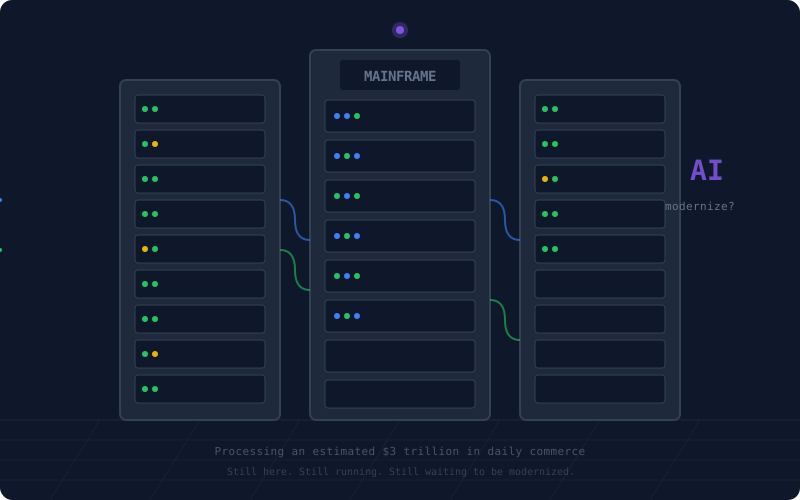
I’ve been thinking about this a lot lately. Everyone’s excited about AI tools like Claude being used to modernize legacy COBOL systems. And they genuinely help, don’t get me wrong. But my hot take? AI won’t modernize your mainframe immediately. At least not by itself.
I say this from experience.
My first project in the mid 2000s was a mainframe-to-SAP migration. 18 months. Clear scope. Migration tools were ready. Two years later? We hadn’t even crossed 25%.
That wasn’t a failure of effort or talent. It was a failure of understanding just how deep the rabbit hole goes.
And this isn’t new. We’ve been trying to get off mainframes for 30+ years. Y2K was supposed to force everyone to modernize. It didn’t. Then came COBOL-to-Java converters. Then model-driven tools. Then cloud platforms. Then low-code rewrites. Every decade had its “this is finally the thing” moment.
And yet the mainframe is still there. Still processing an estimated $3 trillion in commerce every single day.
The problem was never the tooling. It was everything around it.
These systems are 40-60 years old. The people who understood them are gone. The code is the documentation. Half of it looks wrong until you realize it was intentional, for a reason nobody wrote down. You only find out why when something breaks.
And it’s never just the code. You have to move the data, rebuild the batch workflows, the middleware, the security models. All at the same time. Without breaking the thing quietly keeping the lights on.
Then comes the hardest part. Proving it works exactly the same.
For a bank, “close enough” can mean a rounding error of half a cent across 10 million transactions. SOX, Basel III, and other regulatory frameworks don’t care how smart your tool is. They want a clear paper trail down to the last decimal place.
AI is genuinely better than anything before it. It understands context and can reason about code in ways older tools never could. But it still hits the same walls. Missing knowledge, untestable edge cases, organizational resistance, regulatory burden. The walls haven’t changed. Just the tool hitting them.
The companies getting this right treat modernization as a long-term commitment, not a shortcut. They bring the right people, the right process, and realistic expectations. The tool is just one part of that equation.
I learned that lesson in 2007. Still holds true today.
What did your experience look like?