Third place. Champions League football back at Old Trafford. Bruno Fernandes with 21 assists and two Player of the Year awards. On paper, this is the best Manchester United season in years.
So why does it still feel like we only just survived it?
The Amorim era ends with a whimper
After the abysmal season before it, I went into 2025/26 more excited than I had been in years, and the summer business was the reason. Cunha, Mbeumo and Sesko all arrived to join Dorgu from the previous January, and for the first time it felt like Ruben Amorim finally had a squad close to complete. This was supposed to be the year we actually saw his Manchester United, the 3-4-2-1 he had honed at Sporting, imposed on the Premier League.
Not every piece of business thrilled me, though. The one signing that left me genuinely furious was Senne Lammens. Why bring in a goalkeeper from a relatively unknown league when a World Cup winner like Emi Martinez was itching to join Manchester United? It felt like the club talking itself out of an obvious upgrade, and it nagged at me long after the window shut.
As it turned out, I could not have been more wrong. Of all the summer arrivals, Lammens has made the single biggest difference. He is calm, he commands his box, and he has brought a stability to the defence that we simply have not had in years. After enduring the nervy years of Onana and Bayindir between the posts, watching Lammens keep goal is like coming into calm harbour after a long spell lost at sea.
Amorim had arrived in November 2024 carrying genuine excitement. Here was a coach with a clear identity and a reputation for developing young players. After years of managerial musical chairs at Old Trafford, the hope was that someone finally had a plan, and now he had the players to execute it. The opening day seemed to prove the point. We played really well against Arsenal, and I walked away convinced this could be our season.
A few weeks later, then came Grimsby Town. Going out of the Carabao Cup to a League Two side shattered my confidence almost overnight. I started to wonder whether Amorim was out of ideas, and whether the job was simply too big for him.
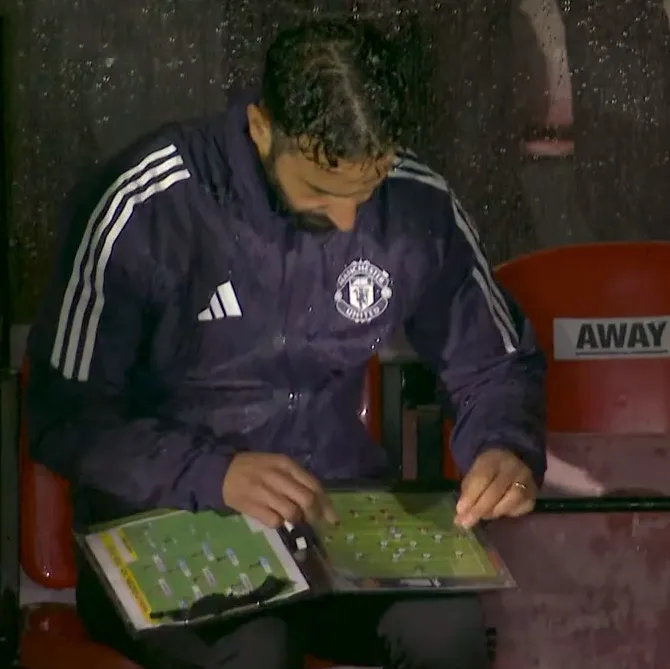 Amorim reaching for answers on the touchline at Grimsby. It was the night my doubts set in.
From there the season settled into a maddening rhythm of one step forward and two steps back. Wins over Chelsea and Liverpool would restore the faith, and then a home defeat to a ten-man Everton would take it all away again. The football never cohered for long. The wing-backs were asked to carry too much of the attacking load, the double pivot left us exposed in transition, and the finishing was quietly catastrophic. United averaged 1.83 expected goals per match but converted just 1.67, a persistent underperformance that drained points throughout the autumn.
The Newcastle game offered a flicker of something different. Amorim changed his formation, and for ninety minutes it looked like evidence of a manager willing to adapt his philosophy. Then he reverted to his original shape the very next game, and the flicker became proof of the opposite, a stubbornness and an unwillingness to bend that came to define his whole tenure.
The single biggest flaw was what he did with Bruno. Playing our most creative player deep in midfield never made sense to me. Stationed so far from goal, his attacking threat was blunted, and the sloppy passes near our own keeper led directly to a handful of critical goals against us. Our most dangerous player was costing us at both ends.
But what ended Amorim was not just the results. It was the noise around them. His press conferences grew increasingly erratic. When he declared after a 1-1 draw at Leeds on January 4 that he had come to United to be the “manager” of the club, not the “head coach,” a distinction that seemed to signal a power struggle with the board, it was over within hours. United felt they had no choice. After 63 games and fewer than 14 months in charge, Amorim was gone. His record tells the story coldly: a 38.1% win rate and 1.23 points per game, the worst of any United manager in the Premier League era. The tactical rigidity and the emotional volatility had become too much to carry.
Carrick changes everything
Darren Fletcher held the fort briefly before United turned to someone no one had quite seen coming: Michael Carrick, the former United midfielder who had most recently been managing Middlesbrough with quiet distinction.
The appointment raised eyebrows. Was Carrick ready for a club of this size? His first two games answered that about as emphatically as possible. Wins over Manchester City and Arsenal, the two best teams in the country, in his opening fortnight sent a jolt of belief through the players and the fans alike. United did not look back. Eleven wins from his first 16 games followed, a stretch only Manchester City could better, worth roughly 2.2 points per game against Amorim’s 1.23. The form since his appointment has genuinely been title-winning.
What changed was not complicated. Carrick put players back in positions they understood. Where Amorim had one formation and one identity, Carrick shifted shape to suit opponents and leaned on Bruno as the creative hub rather than burying him in midfield.
And Bruno responded by producing the best statistical season of his career. Twenty-one assists, a new Premier League season assist record, the last of them arriving on the final day at Brighton. FWA Footballer of the Year. Premier League Player of the Season. That he managed all of this despite spending more than half the campaign stationed in deep midfield only underlines how good he was. A year after serious questions about whether he would even stay at the club, he became the player who encapsulates United’s weird, turbulent, ultimately rewarding 2025/26.
The biggest beneficiary of the change, though, was Kobbie Mainoo. Under Amorim he had effectively been told he was not good enough, reduced to cameos and left warming the bench while a calf injury compounded his frustration. Under Carrick he suddenly looks like one of the best midfielders in the country. Thank goodness United ignored the advice to sell him.
There was a quieter improvement too, one that ran right through the season: set pieces. For once they were a genuine weapon, with 15 league goals from dead balls, nearly double the 8 we managed the year before, and the third-best return in the division. They were creative and effective, and refreshingly free of the wrestling-match routine that Arsenal have turned the penalty box into. Ours actually looked designed to score.
Given everything that came before it, the third-place finish is nothing short of brilliant. Players in familiar positions made all the difference, and getting here under Carrick is a real achievement rather than a lucky one.
The parts that did not work
There is a version of this season review that stops at “third place, Champions League” and calls it progress. That version is incomplete.
Cup football was abysmal. The Grimsby humiliation was only the beginning. United went out of both domestic cups in their first match of each competition, something the club had not managed since 1981/82. For the second consecutive season, there is no trophy. The Europa League run of the year before feels very distant now.
Rasmus Hojlund was shipped out on loan to Napoli, where he flourished alongside Scott McTominay, which raises uncomfortable questions about whether United’s environment or Amorim’s system was the real problem all along. Amad Diallo showed flashes but could not sustain consistency across a full campaign, and the form of both Amad and Mbeumo since returning from AFCON has been a real concern. For all the improvement under Carrick, the defensive structure never quite felt watertight enough to suggest we were genuinely threatening the top two.
What comes next
Carrick has been appointed permanently, confirmed on May 22. That at least removes one variable from what is shaping up to be a genuinely important summer.
Start with the spine, because that is where the hardest work lies. Casemiro’s season was incredible, and replacing him is going to be the toughest ask United’s recruitment department faces all summer. His contract expires and he walks as a free agent, which means his on-pitch authority and his set-piece presence both have to be rebuilt from scratch. The midfield is the clear priority. Ugarte should move on, and United need to bring in three midfielders, with Elliot Anderson of Nottingham Forest reportedly the primary target and Sandro Tonali also linked. Carlos Baleba of Brighton has been linked since last season too, though he has not had the best of campaigns since the speculation began, which cools my enthusiasm a little. Mateus Fernandes of West Ham looks gettable now that they have been relegated, and if the rumours about the Atalanta midfielder Éderson being close prove true, then the other two midfield targets simply have to be top-class starters. Whoever arrives has to carry some of those Casemiro qualities, the security and the threat from dead balls, not just the passing.
Up front, Sesko has started to find his form late in the season, with 7 goals in his final 9 appearances, and looks ready to explode next year, but he needs an experienced Premier League striker alongside him rather than just a raw understudy. Cunha has been a solid performer throughout, chipping in with double figures of goals and assists combined.
The defence is in good shape. Maguire and Martinez have been excellent, and de Ligt looked outstanding before a long injury absence took him out. Ayden Heaven and Leny Yoro are both developing nicely. Luke Shaw starting almost every game is a genuinely surprising stat, though he does seem to rediscover his fitness in a major international tournament year, doesn’t he? The full-back slots are fine, but a young left-back should be on the list for next season. Mason Mount played as a central midfielder in a couple of games towards the end, which suggests Carrick sees him there, but in truth he is more of a versatile squad option than a first-choice eight.
The money makes all of this possible. Champions League revenue, estimated at around £100m in additional income, unlocks a transfer war chest that simply was not available last summer. In my view United should be planning for a minimum of five signings this window, and anything less would be a wasted opportunity. The departures make the case on their own: Rashford, Onana, Ugarte, Zirkzee and Hojlund are all expected to move on, while Casemiro, Sancho and Malacia all leave for free. This is essentially a rebuild of the spine of the squad in a single window.
That is both exciting and daunting. United have made this mistake before, spending heavily in one summer without enough coherence and ending up with a bloated squad full of players who do not fit a system. What is different this time, or what I hope is different, is that Carrick has earned the right to define that system himself. He is not inheriting someone else’s players or someone else’s formation. The summer will tell us how much authority he actually has.
Third place. Champions League. Bruno’s twenty-one assists. Michael Carrick, permanent manager, age 44.
After the chaos of Amorim’s exit and the weeks of uncertainty that followed, finishing here feels like more than it probably should. United fans have recalibrated their expectations enough times that a top-three finish now registers as relief rather than expectation.
But maybe that recalibration is healthy. This squad, with the right additions and a clear identity from the manager, could genuinely challenge next season. Or it could unravel again in October. With Manchester United, both feel equally plausible, which is part of what makes supporting them so exhausting and, on the good days, so worth it.