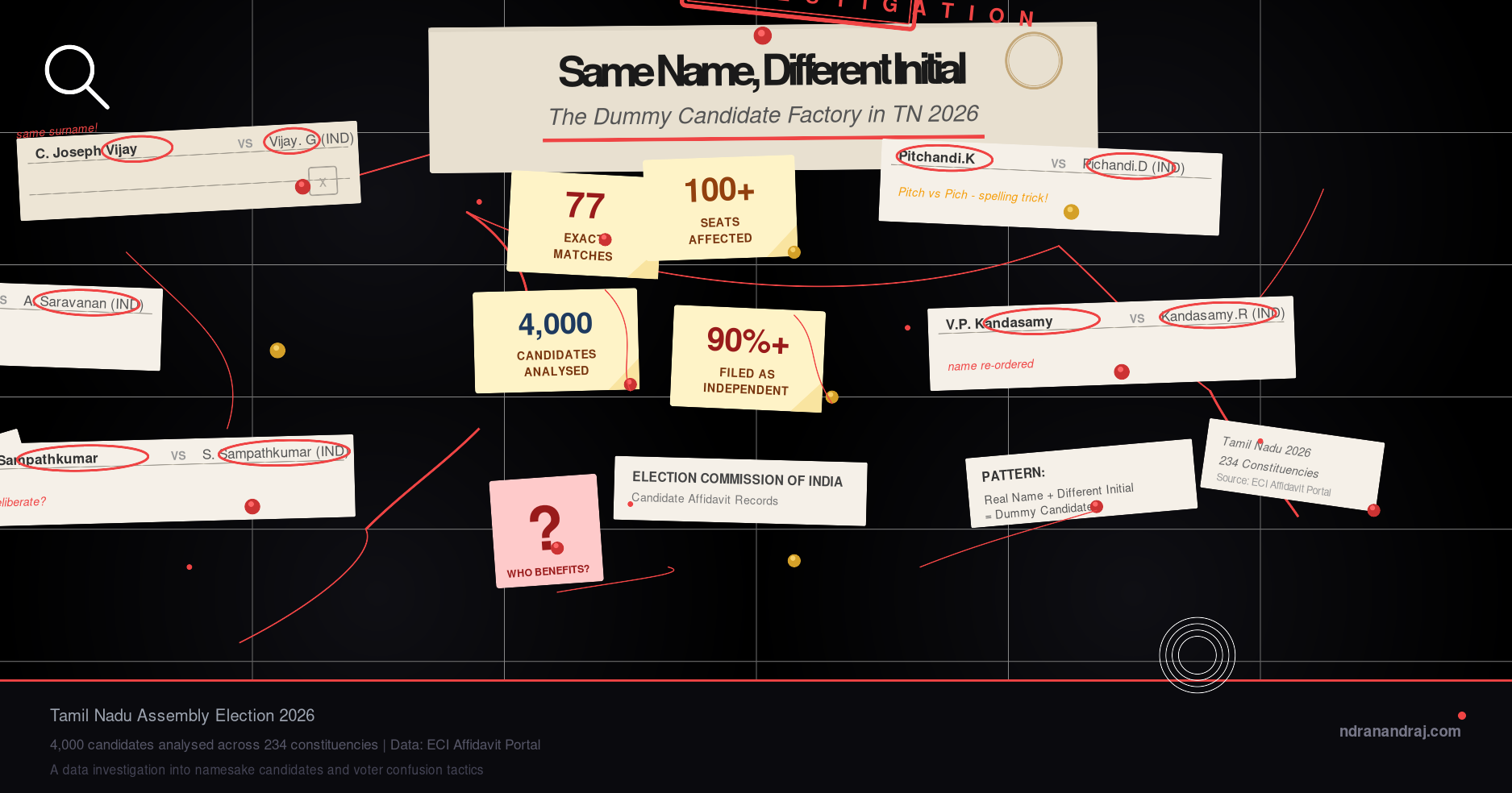
Perambur is the most watched constituency in Tamil Nadu this election. The reason is one name: C. Joseph Vijay, the actor, making his political debut as TVK’s candidate. Millions know him simply as Vijay. The ballot, however, has other ideas. Alongside C. Joseph Vijay, voters in Perambur will find “Vijay” contesting under the All India Jananayaka Makkal Kazhagam banner. They will also find “Vijay. G,” an Independent. And then there is “M. Joseph” and “S. Joseph,” two more Independents who carry the other half of the star candidate’s name. Four candidates, each carrying a fragment of one man’s identity, none with any realistic path to victory. Together, they form a small constellation of confusion around the most high-profile nomination in the state.
Perambur is not an exception. It is the most visible example of something happening across Tamil Nadu.
I scraped all 4,000 accepted nominations from the Election Commission’s affidavit portal for the 2026 Assembly Election and ran a name-similarity analysis across every one of the 234 constituencies. The results reveal a pattern that is difficult to explain away as coincidence. Across more than 100 constituencies, candidates with names nearly identical to major party nominees have filed as Independents, creating deliberate ballot confusion in what is shaping up to be Tamil Nadu’s most competitive election in a generation.
Take Alandur. The ADMK candidate is S. Saravanan. Also contesting: A. Saravanan, D. Saravanan, and R. Saravanan, all three Independents, none with a party machine, none with alliance backing, none with any realistic shot at winning. They exist on the ballot for one purpose: to make voters hesitate at the EVM.
This is not an Alandur problem, and it is not a Perambur problem. It is a system.
The Numbers
Out of 4,000 candidates across 234 constituencies, I found 77 exact name matches, cases where, after stripping initials and honorifics, two candidates in the same constituency have literally the same name. V. Sampathkumar and S. Sampathkumar. Dineshkumar. N and Dineshkumar. V. Ramachandran.S and Ramachandran.K. Same surname, different letter in front of it.
Beyond exact matches, another 50 or more near matches turned up, names with minor spelling variations that would trip up any voter scanning a ballot quickly. Nithyanandhan versus Nithyanandan. Pitchandi versus Pichandi. Vijayabhaskar versus Vijaya Baskar. And dozens more word-level matches, where a significant part of a major candidate’s name shows up in another candidate’s entry.
The suspect candidates are overwhelmingly Independents. Over 90% of the flagged dummy candidates filed under no party banner. This matters because filing as an Independent requires almost nothing: no party approval, no ideology, no ground organisation. Just a deposit and a nomination form.
Who Gets Targeted
Every major alliance is a target, but not equally.
NDA candidates face the most dummy pairs. ADMK, BJP, PMK, and DMDK nominees collectively have the highest count of namesake opponents. ADMK alone, contesting 169 seats, has namesakes in dozens of them. In Sulur, the ADMK candidate V.P. Kandasamy is matched by Kandasamy.A, Kandasamy.R, and Kandasamy.V, three Independents, all variations of the same name.
INDIA alliance candidates are next. DMK nominees in particular face the treatment. In Kilpennathur, the DMK’s Pitchandi.K is joined on the ballot by Pichandi.D, Pichandi.R, and Pichandi.V, three near-identical names exploiting the Tamil “tch” versus “ch” spelling variation that would confuse even an attentive voter.
TVK, contesting its first ever election, is not spared. In Coimbatore North, TVK’s V. Sampathkumar faces S. Sampathkumar (an exact match), plus K. Sampath Kumar and R. Sampath Kumar (near matches), four candidates with functionally the same name on one ballot. The Perambur case around Vijay is the most brazen, but the Coimbatore North case is arguably more insidious because it involves a less famous candidate who voters may not recognise by face.
The Hotspots
Some constituencies are worse than others.
Kalasapakkam has both its INDIA and TVK candidates targeted simultaneously. Saravanan from DMK has two namesakes, one Independent and one from a micro-party, while Elumalai from TVK has two more. Kilpennathur is a laboratory of the tactic: the ADMK candidate, the DMK candidate, and the TVK candidate all face namesake Independents, seven suspicious pairs packed into a single constituency.
Thousand Lights in Chennai is another striking case. ADMK’s Valarmathi.B faces Valarmathi.E (an exact match) and Valarmathy.D (a near match with the “thi” versus “thy” spelling variant). Meanwhile, TVK’s Prabhakar faces Prabhakaran.B, Prabhakaran.T, and Prabhakaran.V, three spelling variants, all Independents, all clustered around one candidate.
The pattern is not random. It concentrates in competitive seats where margins are expected to be thin, where even a few hundred confused votes could flip the outcome.
Why It Works
Tamil Nadu uses EVMs with candidate lists that include names and party symbols. But within a long list of 15 to 20 candidates per constituency, voters scanning for a familiar name can easily press the wrong button. The confusion does not need to be widespread. In a state where 94 seats were decided by fewer than 13,000 votes in 2021, and several by fewer than 500, diverting even a few hundred votes through name confusion can be decisive.
The deposit for an Independent candidate in a state assembly election is Rs 10,000 (Rs 5,000 for SC/ST candidates). That is the total cost of putting a dummy on the ballot. If a dummy candidate pulls even 200 to 300 confused votes from the target, the cost per diverted vote works out to roughly Rs 30 to 50. No campaign rally, no door-to-door canvassing, no manifesto required. Just a name on a form and a deposit at the returning officer’s counter.
Consider the arithmetic. In 2021, Theayagaraya Nagar was decided by 137 votes. Modakurichi by 281. Tenkasi by 370. In seats this close, two or three dummy candidates pulling a hundred votes each could change which party wins, which alliance forms the government, which chief minister takes oath. The entire machinery of state, potentially redirected by a few names on a form.
What the Law Says
The Representation of the People Act does not explicitly prohibit namesake candidatures. The Election Commission has acknowledged the problem in the past but has no mechanism to reject a nomination purely because the candidate’s name resembles another’s. As long as the paperwork is valid and the deposit is paid, the nomination stands.
Some political parties have petitioned for reforms: unique candidate identifiers, larger photographs alongside names on EVMs, or stricter scrutiny of nominations that appear designed for confusion. None have been implemented at scale. The dummy candidate remains the cheapest, lowest-risk form of electoral manipulation available in Indian democracy. It requires no violence, no booth capturing, no tampering with machines. It works by exploiting the gap between a voter’s intent and the ballot’s design.
A Note on Method
I downloaded all 461 pages of accepted candidate nominations from the ECI’s affidavit portal (affidavit.eci.gov.in), parsed the HTML, and loaded the data into a PostgreSQL database. The similarity analysis normalises each name by stripping titles (Dr., Thiru., Smt.), removing single-letter initials, and comparing what remains. An “exact match” means two candidates have the identical name after normalisation. A “near match” means 85% or higher string similarity. A “word match” means a significant part of one name, four or more characters, appears in the other.
Not every flagged pair is a deliberate dummy. Common Tamil names like Kumar, Selvam, Raja, and Murugan naturally recur across any large candidate list. But when three Independents named Kandasamy appear in the same constituency as an ADMK candidate named Kandasamy, or when four variations of “Vijay” and “Joseph” appear on the same ballot as C. Joseph Vijay, the burden of coincidence becomes difficult to sustain.
Explore the Data
The full analysis, covering every suspicious pair, filterable by alliance, match type, and constituency, is in the interactive dashboard below. You can search for your constituency, see exactly who the target and suspect candidates are, and judge the evidence for yourself.
Data scraped from the Election Commission of India Affidavit Portal on April 17, 2026. Analysis covers all 4,000 accepted nominations for the Tamil Nadu 2026 Assembly Election across 234 constituencies. Code and methodology available on request.